
The Rise of High-End Modular Living Across North America
Luxury and prefab are no longer opposites. A new tier of high-end factory-built homes is redefining premium residential construction across North America.
Admin
10/12/20263 min read

Prefab Goes Luxury
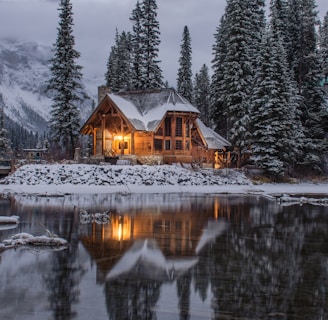
There is a house in the hills above Ojai, California that looks like it was designed by a Japanese architect obsessed with California modernism. Floor-to-ceiling glass. A cantilevered deck over a dry riverbed. Blackened cedar cladding. Custom-milled concrete countertops. It was built in a factory in 73 days. The luxury prefab market is not a contradiction. It is the most exciting design frontier in North American residential construction, and it is growing fast enough that some of the most respected architects on the continent are now building their practices around it.
WHY LUXURY AND PREFAB ARE A NATURAL FIT
The misconception that luxury requires bespoke on-site craftsmanship is dissolving. Here is why factory-built and high-end are actually complementary:
Precision. Luxury design depends on exact tolerances. A miter joint, a threshold reveal, a window-to-ceiling gap; these details define the quality of a high-end finish. In a controlled factory environment, these tolerances are held consistently in ways that are nearly impossible to guarantee on a construction site exposed to weather, labour variability, and time pressure.
Speed. In a luxury market where clients have specific lifestyle goals: the mountain home that needs to be ready for ski season, the lakeside retreat that needs to be operational before summer — the compressed timeline of prefab construction is a feature, not just a budget consideration.
Sustainability credentials. The luxury market has fully embraced sustainability, not as a compromise but as a design language. Factory-built homes generate approximately 50% less construction waste than site-built equivalents, come with tighter building envelopes, and integrate renewable energy systems more easily. For the high-end buyer, this is a selling point, not an afterthought.
WHAT THE LUXURY PREFAB MARKET LOOKS LIKE RIGHT NOW
Across North America, a distinct tier of luxury modular manufacturers has emerged, offering products that bear no resemblance to the prefab of a generation ago:
In Canada: Manufacturers in BC, Ontario, and Quebec are delivering custom modular homes in the $600,000–$2,000,000+ range, featuring mass timber structures, triple-glazed European window systems, geothermal HVAC, and interior finishes drawn from the same material palette as high-end custom homes.
In the United States: Companies focused on the architect-designed modular market are delivering projects in luxury coastal, mountain, and urban markets. High-profile architects; including several alumni of major firms, have specifically chosen prefab as their primary delivery method for residential work.
Globally: Scandinavian, Japanese, and Australian luxury prefab manufacturers are increasingly active in the North American market, bringing design languages and engineering standards that are raising the bar for local producers.
THREE THINGS THAT SEPARATE GOOD LUXURY PREFAB FROM GREAT LUXURY PREFAB
If you are in the market for a high-end factory-built home, here is how to evaluate the quality of what you are being offered:
1. The Joint Detail
Where modules connect: both externally at the façade and internally at the ceiling and floor, is where premium craftsmanship shows. Ask to see detailed drawings of the connection system and, if possible, visit a completed home in person to inspect the joint quality.
2. The Finish Schedule
A genuine luxury prefab home will have a comprehensive finish schedule: specific product specifications for flooring, tile, millwork, hardware, and fixtures. If your builder cannot provide this level of specification, the "luxury" label is marketing, not reality.
3. The Mechanical Integration
Luxury means comfort as well as beauty. How is the HVAC system designed? Is it a single-zone or multi-zone system? Are the radiant floor systems pre-installed in the factory? Is there capacity for home automation integration? The mechanical quality of a prefab home is as important as its aesthetics.
THE INVESTMENT CASE FOR LUXURY PREFAB
Beyond lifestyle, luxury prefab is an investment thesis. In markets where comparable custom site-built homes take 18–30 months to deliver, a well-executed prefab can be built and operational in 9–12 months. For buyers purchasing for vacation rental income as well as personal use, this time advantage is worth tens of thousands of dollars in lost revenue avoided.
Resale data from the luxury modular sector is still thin in most markets, but early evidence from California, Colorado, and British Columbia suggests that architect-designed prefab homes are holding their value in line with, and in some cases exceeding, comparable custom site-built homes. The stigma premium is disappearing. In its place, a quality premium is emerging for the best factory-built homes.
HOW PREFABIQ SUPPORTS LUXURY BUILDS
Managing a luxury prefab build requires the same rigour as managing a custom project — or more, given the manufacturing supply chain involved. PrefabIQ's Project Management module gives owners and their builders a single source of truth for schedule, specifications, and change orders, while the Document Hub ensures that the manufacturer's certifications, warranty documentation, and finish specifications are stored and accessible for the life of the home. Luxury and prefab are not opposites. They are, increasingly, the same sentence.
PREFAB SOLUTIONS
LOCATION
STAY UPDATED
info@prefabsolutions.ca
© 2025. ALL RIGHTS RESERVED
1000784075 ONTARIO CORPORATION OCN/BIN Numéro de société de l’Ontario/NIE: 1000784075
CONTACT
We are a digital first company based in Toronto, Ontario, Canada
SOCIAL
OUR BRANDS
Prefab Essentials
Prefab Match
Prefab Collective
The Modularity Group Inc. is a company with multiple business holdings. Prefab Solutions serves consumers with prefab construction advocacy. PrefabIQ serves consumers with housing construction and management software. Prefab Match is in the housing listing industry. Prefab Essentials retails premium décor and furnishings, while Prefab Collection offers a membership-based community for enthusiasts to share and learn. While each company operates as a separate entity, we all function on the foundational principle: the future of living is smarter, it is more flexible, it is about precision over excess, it is about community over going it alone—and it is also modular. We believe a well-designed home is a symphony of integrated parts; a harmonious blend of space, light, and function.
D-U-N-S NUMBER 243369819