
Guide to Safely Cleaning Prefab, Modular, and Tiny Homes (Canadian Edition)
General
Admin
5/6/20268 min read


Under Pressure: The Complete Guide to Safely Cleaning Prefab, Modular, and Tiny Homes (Canadian Edition)
You’ve invested in a modern prefab, modular, or tiny home—engineered for efficiency, built to Canadian standards, and designed to last. But when spring arrives and that layer of winter grime needs to go, can you simply break out the pressure washer like you would with a traditional home?
The short answer is: yes, but with significant caution and an awareness of Canadian regulations. The longer answer requires understanding the unique materials, CSA certifications, and construction methods that make prefab homes different, as well as the environmental and consumer protection laws that govern exterior cleaning in Canada.
This guide covers everything Canadian stakeholders need to know, from homeowners to professional cleaning companies; to keep these innovative homes looking their best without causing costly damage or running afoul of regulations.
Part 1: Understanding What You’re Working With – The CSA A277 Factor
The Certification That Matters
In Canada, prefabricated buildings, modules, and panels are subject to CAN/CSA-A277, the national standard for certification of prefabricated buildings. This standard governs how factory-built components are manufactured, inspected, and documented to ensure compliance with the National Building Code (NBC) and local codes. Why does this matter for pressure washing? Because CSA A277 certification dictates specific requirements for:
Seal integrity: Modules are engineered with specific weatherproofing systems that must remain intact
Material specifications: Factory finishes may differ from site-applied equivalents
Ventilation and opening placements: Prefab homes have specific venting patterns that can be vulnerable to forced water
The Canadian Home Builders' Association (CHBA) notes that certified factories maintain: "meticulous documentation, including travel logs and serial numbers for each unit for a minimum of 5 years". This documentation includes the specific sealants and weatherproofing materials used; information that becomes valuable if you need to verify chemical compatibility when cleaning.
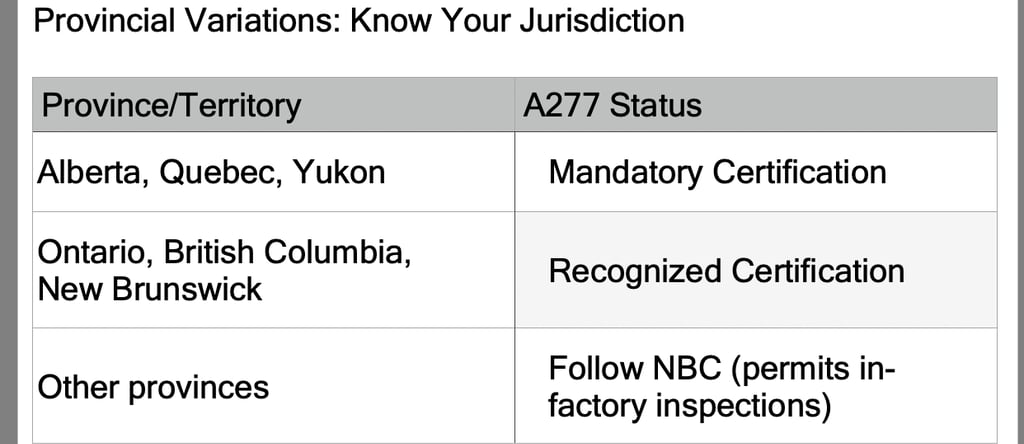
Provincial Variations: Know Your Jurisdiction
The application of CSA 277 varies by province :
Before cleaning, check whether your home came from a CSA A277-certified factory. If not, contact the manufacturer for specific cleaning recommendations, they are required to maintain records of materials used.
Part 2: Environmental Regulations – Where Your Wash Water Must Go
The Fisheries Act
Canada has strict regulations governing where wash water can be discharged. Under the Fisheries Act, it is a contravention to deposit any 'deleterious substance' into fish-bearing waters. This includes wash water containing:
Paint chips or residue
Soaps and detergents
Algae, mould, or mildew spores
Dirt containing oils or chemicals
Environment and Climate Change Canada guidance on wash water management states that wash water: "must not be allowed to enter the aquatic environment" and that proper containment is the first step.
What This Means for Homeowners
If you are pressure washing your home, you cannot simply let the water run off into the street, storm drains, or nearby ditches. Options include:
Containment: Use tarps or barriers to collect wash water and direct it to a grassy area where it can filter into the ground (verify this is permitted in your municipality)
Sanitary sewer discharge: If permitted by local bylaws, wash water can be discharged into the sanitary sewer system, never storm drains
Professional handling: Hire a company that captures and properly disposes of wash water
Provincial Variations
In British Columbia, wash water containing certain residues may be classified as hazardous waste under provincial Hazardous Waste Regulations. Contact your provincial environment ministry for specific requirements.
The precautionary principle is embedded in the Canadian Environmental Protection Act, 1999 (CEPA), which states that: "lack of full scientific certainty shall not be used as a reason for postponing cost-effective measures to prevent environmental degradation". When in doubt, contain and capture rather than allowing runoff.
Part 3: Signs of Quality in a Canadian Prefab Home
Before applying any cleaning method, verify that your home was properly manufactured and installed. The CHBA outlines key indicators of quality prefab construction :
What to Look For:
Serial number and specification sheet attached to the electrical panel
Documentation showing design loads (wind, snow, seismic) for your region
Confirmation of compliance with energy efficiency and local climate requirements
Plumbing test records (rough-in and drainage, waste, and vent testing)
Moisture content checks on lumber
Electrical insulation resistance test records
If this documentation is missing from your electrical panel, contact the manufacturer; it should have been provided at installation. This documentation also includes information about sealants and finishes that affect cleaning methods.
Part 4: Consumer Protection – Hiring a Pressure Washing Company
Canadian Contract Law Basics
When hiring a pressure washing company in Canada, you are entering into a home improvement contract. Several provinces have specific requirements for such contracts.
Manitoba Example: The Consumer Protection Act
Under Manitoba's Consumer Protection Amendment Act (Home Improvement Contracts), any home improvement project totaling more than $500 requires a written contract containing specific information, including:
Details of the scope of work
The total amount to be charged
The contractor's name and contact information
The start and end dates (or ranges) for the project
A description of the type or grade of materials to be used
A list of each required permit and who is responsible for obtaining it
A statement about whether the contractor has workers compensation coverage and insurance
The contract must be signed and dated by both parties, and a copy must be provided before work begins.
Ontario: Door-to-Door Sales Restrictions
In Ontario, certain restricted products and services; including duct cleaning, water heaters, air conditioners, and furnaces cannot be sold door-to-door unless the consumer initiates contact. While exterior cleaning is not specifically restricted, this legislation demonstrates Ontario's strong consumer protection framework.
Key consumer rights in Ontario:
Right to void the contract if misleading statements were made
Right to cancel within one year if the contract fails to include required information
10-day cooling-off period to cancel any contract signed in your home, for any reason and without penalty
Red Flags When Hiring a Pressure Washing Company
No written contract for jobs over $500
Vague answers about waste water disposal
Pressure to sign immediately without time to review
Door-to-door solicitation of restricted services (check your province's rules)
Refusal to provide proof of insurance or workers compensation coverage (required in several provinces)
Questions Every Canadian Homeowner Should Ask
"Are you familiar with CSA A277 certified homes?" – A knowledgeable company will understand prefab construction.
"How do you handle wash water disposal?" – The answer should include containment and proper discharge, not "it runs to the street."
"Do you carry workers compensation insurance?" – This protects you if a worker is injured on your property.
"Will you provide a written contract before starting?" – Required for projects over $500 in several provinces.
"What cleaning chemicals do you use?" – Ensure they won't degrade factory-installed sealants or finishes.
Part 5: Best Practices for Pressure Washing Canadian Prefab Homes
What to Do
Check your home's documentation first. Locate the specification sheet at your electrical panel. Note the materials used and any manufacturer cleaning recommendations.
Test a small, inconspicuous area. Before committing to the entire home, test your pressure and technique on a back corner. Check for paint lifting, water infiltration, or surface damage.
Use the correct pressure for each surface. For vinyl siding (common on panelized homes), use 1,300–1,600 PSI. For metal panels, 1,500–2,000 PSI. For wood or T1-11, use soft wash only (under 1,200 PSI).
Use a wide spray angle (25-40 degrees). Narrow nozzles (0-15 degrees) concentrate force dangerously and can damage factory seals.
Spray at a downward angle. Never spray upward at seams; this forces water behind panels and into the engineered connections between modules.
Protect electrical and vent openings. Cover exterior outlets, vent covers, and any factory-sealed openings with plastic sheeting and tape.
Contain your wash water. Use tarps or barriers to prevent runoff into storm drains or water bodies.
What to Avoid
Never use a zero-degree (red) nozzle on any prefab surface. This concentrates pressure into a cutting stream capable of stripping paint, gouging siding, and penetrating engineered seals.
Don't spray directly at module seams or joints. The connections between modules are designed for rain, not 1,500 PSI direct pressure.
Never allow wash water to enter storm drains or water bodies. This can violate the Fisheries Act and result in significant fines.
Avoid cleaning in direct, hot sunlight. Water evaporates quickly, leaving cleaning agents as residue that can streak or spot surfaces.
Don't use bleach or harsh chemicals without checking manufacturer specifications. These can degrade the anti-corrosion coatings and seals used in CSA A277 certified homes.
Part 6: For Pressure Washing Companies – Excelling in the Canadian Prefab Niche
Know the Standards
Understanding CSA A277 is essential. The standard requires certified factories to maintain quality assurance programs, including:
Personnel qualifications
Detailed record-keeping
Process checklists
Homes built to this standard have specific engineered vulnerabilities that generic cleaning approaches may exploit. Familiarize yourself with the common sealant types and weatherproofing systems used by major Canadian prefab manufacturers.
Liability Considerations
Carry higher liability limits. Prefab home replacement costs can be significant.
Document everything. Before-and-after photos, signed estimates, and inspection checklists are your best defense against damage claims.
Know your exclusions. Be clear about what you won't clean (e.g., asphalt roofs, certain stucco finishes, unsealed wood).
Wash Water Compliance
Government guidance emphasizes that wash water must be contained and collected. Companies should:
Use capture systems (tarps, barriers, vacuum recovery)
Dispose of wash water properly, never into storm drains
Be aware that provincial regulations may classify certain residues as hazardous waste
Marketing Your Prefab Expertise
Position yourself as the specialist Canadian homeowners need. Highlight your knowledge of:
CSA A277 certification and what it means for cleaning
Province-specific consumer protection requirements
Appropriate PSI for different prefab siding types
Proper wash water containment and disposal
Part 7: When to Choose Alternative Methods
Pressure washing isn't always the answer. For routine maintenance, gentler approaches may be sufficient.
Soft Washing (Under 500 PSI)
Soft washing uses low-pressure spray combined with biodegradable cleaning solutions that kill mold, mildew, and algae at the source. The pressure is low enough to be safe for virtually all prefab surfaces, including roofs. For homes with wood siding, stucco, or older finishes, this is the preferred method.
Hand Washing
For small tiny homes or homes with delicate finishes, a soft-bristle brush, bucket of mild soapy water, and garden hose remain effective. This method eliminates all pressure-related risks and allows close inspection of surfaces as you clean.
Part 8: Maintenance Schedule for Canadian Prefab Homes
Canada's diverse climate, from coastal humidity to prairie winters, demands regionally appropriate maintenance.
Recommended frequency:
General exterior cleaning: At least every few months
High-pollution or coastal areas: Monthly cleaning may be necessary
Gutter and downspout checks: Twice yearly (spring and fall)
Seal and seam inspection: Quarterly, focusing on door frames, window frames, and roof-to-wall joints
Anti-corrosion coating inspection: Annually in coastal or high-humidity areas
For steel-framed prefab homes: sand and repaint rusted areas on steel surfaces within 48 hours of damage to prevent structural degradation.
Pressure Washing Is a Tool, Not a Solution
Pressure washing can restore your Canadian prefab, modular, or tiny home's appearance efficiently—but only when used correctly and in compliance with Canadian regulations. The unique materials, CSA A277 certifications, and engineered seams of these homes demand more care than traditional site-built construction.
For homeowners: Know your home's documentation, your provincial consumer rights, and your environmental responsibilities. Protect vulnerable seams, contain your wash water, and never hesitate to hire professionals who understand prefab construction.
For cleaning companies: Specialize in CSA A277 knowledge, train thoroughly on wash water containment, document everything, and carry appropriate insurance. The growing Canadian prefab market represents a significant business opportunity for those who approach it with expertise rather than brute force.
When in doubt, remember the core principle: the gentlest effective method is always the safest method. Your home; whether certified to CSA A277 or built to NBC standards, deserves nothing less.
This guide provides general information and does not constitute legal advice. Always verify your province's specific requirements with local authorities.
References:
CAN/CSA-A277-16 - Procedure for certification of prefabricated buildings, modules, and panels
Manitoba Consumer Protection Amendment Act (Home Improvement Contracts)
Fisheries Act (Canada) – Wash water management guidance
Canadian Environmental Protection Act, 1999 (CEPA)
Ontario Consumer Protection Act, 2002 – Door-to-door sales rules
Canadian Home Builders' Association – Code compliance for modular buildings
PREFAB SOLUTIONS
LOCATION
STAY UPDATED
info@prefabsolutions.ca
© 2025. ALL RIGHTS RESERVED
1000784075 ONTARIO CORPORATION OCN/BIN Numéro de société de l’Ontario/NIE: 1000784075
CONTACT
We are a digital first company based in Toronto, Ontario, Canada
SOCIAL
OUR BRANDS
Prefab Essentials
Prefab Match
Prefab Collective
The Modularity Group Inc. is a company with multiple business holdings. Prefab Solutions serves consumers with prefab construction advocacy. PrefabIQ serves consumers with housing construction and management software. Prefab Match is in the housing listing industry. Prefab Essentials retails premium décor and furnishings, while Prefab Collection offers a membership-based community for enthusiasts to share and learn. While each company operates as a separate entity, we all function on the foundational principle: the future of living is smarter, it is more flexible, it is about precision over excess, it is about community over going it alone—and it is also modular. We believe a well-designed home is a symphony of integrated parts; a harmonious blend of space, light, and function.
D-U-N-S NUMBER 243369819